2014年3月9日星期日

How to Qualify for the EPT: Beating the $22 Rebuy

This is the sixth article in a seven-part series from EPT Serial Qualifier Pierre Neuville. Check back every Thursday for the next in the series.
See the list of all articles in the series below.
The $22 Rebuy EPT qualifier on PokerStars is a tricky tournament as there is only one or two EPT seats available.
The goal with this article is to give you the best chance for a return on your investment.

Step 1: Understand the Different Parts of the Tournament

First step: Distinguish the two completely different parts of the tournament.
Part A: The Re-Buy Period
The objective in the re-buy stage is to survive as economically as possible while at the same time building a stack marked cards, little by little, to have enough chips for the increasing blinds.
The last 10 minutes before the add-on period, in fact, can be quite expensive given how fast the blinds are rising.
At the beginning of the re-buy period, you can do a double re-buy to truly double your stack up to a full 20,000 if you have the chance.
Lesson 6 shorthanded 8880
Get to the rebuy and half the field is gone.
But, during this period, you have to play very economically – meaning no flips for 5,000 or 6,000 chips.
These won’t increase your chances of qualifying.
The only goal – never to lose sight of – is to get to the add-on period without spending too much.
This is achieved by going into a mode of play that’s a bit unusual – essentially you don’t “play” poker during this period.
You “survive economically,” see very few flops and maximize your return if there's an opportunity.
When you’re in the pre-add-on period, you must only do one re-buy at a time … and then try to survive until you find a flop that can quadruple you up.
First Benefit of the Add-On Stage: Fewer Players to Share the Money
Congratulations.
You’ve made it to the add-on stage, where 50% of the players who started the tournament have already dropped out.
This is the first benefit of this type of qualifying tournament: the prize money is now divided up between a much smaller group of players.
In the long run, we can have infrared contactlenses a very good ROI in this tournament if we play into the add-on period every time.
In fact the real tournament doesn’t even begin until the add-on stage - and the number one advantage is that fewer players will share the overall prize money.
Part B: The Add-On Stage
The add-on is 50,000 chips and each player now starts a new tournament where everyone has virtually the same stack  - between 55,000 and 100,000+.
boeree pierre
Get the seat and Boeree awaits.
Also of note here: there is often a few payout spots of €500 in these tournaments on top of the sole winner of the qualifier.
So for a good return, watch out for this bubble before taking the risks you need to win the “winner takes all” part of the tournament.
In Summary:
Basically there are three parts to the $22 re-buy tournaments:
1) The first part, where the objective is to arrive at the add-on stage, absolutely, but to get there as cheaply as possible.
2) The second part is between the add-on stage and the money bubble (if there are extra payout spots) where you can look to get a small return on your investment
3) The “winner takes all” stage once the payouts are reached where the real battle for qualification begins
These require three different strategies altogether depending on the period.
If your average re-buy cost stays around €240, this tournament is very profitable if you win one in 12.
Good luck!


2014年3月7日星期五

SNG ABCs: Calling Short-Stack All-Ins

Everyone knows that the key to winning sit-and-gos is to play aggressively. However, that isn't always going to be possible.
When you're in the big blind and have a short-stack all-in in front of you, aggression isn't going to help you. You either call or you fold.
So how do you decide which route to take?
Well, first of all, you can go by hand quality. If you have a great hand, it makes your decision fairly easy.
If, however, your holdings are less than stellar, you have to judge by more than hand quality: you look at the odds.
What Exactly are the Required Odds?
Many players don't take odds into account at all when deciding whether to call a short-stack shove.
They think, "Oh, he's all-in - he must have a hand. My T-8 must be no good."
This is incorrect. Though your T-8 may indeed be a dog, you may be getting the required odds to call marked cards.
So what exactly are the "required odds?"
There's no way to determine the exact required odds, because you don't know for sure what your opponent's holding.
However, in my four-part sit-and-go article I advise, "If you are getting 2-1 or better, you'd better have a good reason for folding."
Meaning that unless this guy is the tightest player in the world, at those odds you should probably be calling.
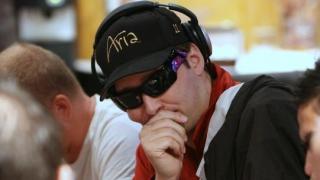
Phil Hellmuth
If you're getting 2-1 or better and have a decent stack, you should be calling.
 
If it is late in the tournament and the player is short-stacked, he'll be shoving all-in with a very wide range of hands.
I'm not just talking about premium AA, A-K, JJ type hands.
Instead, they'll be pushing all sorts of hands, ones like 9-8, 44, J-Q and even the occasional super spazzy 5-3o.
No two unpaired cards are a huge favorite over two other live unpaired cards.
So if you are getting 2-1 or better and have a decent stack, you should almost always be looking up short-stack shoves.
Let's take a look at how some random hands stack up against other random hands:
A-K vs. 9-8 9-8 will go on to win 36% of the time
A-Q vs. J-Ts J-T will go on to win 41% of the time
44 vs. T-9 T-9 will go on to win 50.3% of the time
A-T vs. 4-7 4-7 will go on to win 35% of the time
A-T vs. T-8 T-8 will go on to win 27.5% of the time
As you can see by this small sampling, the only time you are really a dog is when you are dominated like in the T-8 versus A-T hand.
Other than that, you are almost marked cards contactlenses always 35-40% to win. Thus it would be a huge mistake to fold getting 2-1 or better on a 40% shot.
Think of it this way: if you could bet on flipping a lopsided coin all day that would land heads 40% of the time and tails 60% of the time, and you would be paid out at 2-1 for every heads, you would be rich by the end of the day.
So why pass up that same bet in a poker game?
Let's take a look at an example:
$100/$200 blinds. You're in the big blind with $6,000.
The small blind has $500 after posting. It's a full table and there is a $25 ante.
It's folded around to the SB, who shoves all-in for a total of $600. You're in the BB with T 7.
Should you call?
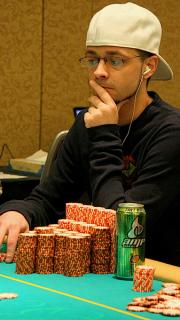
Kevin Saul
All you need is some 7th-grade math.
 
Let's do a little light seventh-grade math.
The SB is in for $600; there is $250 in from the antes, and you already have $200 in.
That makes a total of $1,050. You have to call $400 more to win $1,050.
So should you call? Absolutely. This is almost an any-two-cards situation. Getting 3-1 makes folding almost completely out of the question.
Now of course in a perfect world, you would never have to call with a hand that's behind your opponent's range.
You could just raise everyone else's blinds and steal your way to victory.
But in reality, that won't work. You are going to run into this situation.
And if you make a habit out of folding when you're getting 2-1 odds or better against a shorty, you're making a big error.